



What Is Voice Search Optimization?
You must have heard of Amazon Alexa, Siri, Cortana and Google Assistant, which are used for voice interaction, music playback, making to-do lists, setting alarms, streaming podcasts, playing audiobooks, and providing weather, traffic, sports or any other kind of information. These assistants make voice search possible: you can ask a question and receive a spoken response in return.
Voice Search Optimization is the optimization of keywords and keyword phrases for searches made using voice assistants, so that your pages appear in voice searches. It is similar to Search Engine Optimization (SEO), where content is created for users who seek information.
According to Statista, at least 20% of queries on Google’s mobile app and Android devices fall under the Internet of Things (IoT), such as smart TVs. It is evident that most searches nowadays are made using either a smartphone or a smart speaker.
Benefits of Voice Search Optimization
Suppose you are in the kitchen and need to check a recipe, but your hands are wet and dirty. All you need to do is ask for the recipe without even touching your phone. Voice Search Optimization simplifies your life without interfering with your daily routine. You can search or ask anything while driving, eating, cooking, playing, writing and so on.
There are numerous benefits of using Voice Search Optimization. First of all, it:
- allows users to multitask more easily;
- helps them do things faster;
- gives answers instantly;
- makes day-to-day life easier; and
- delivers more accurate answers.
This is why search engines such as Google place such a strong emphasis on Voice Search Optimization: the main aim of SEO is to rank websites in such a manner that users can find the best responses to their questions as fast as possible. Ultimately, user experience is at the forefront of SEO.
Voice Search vs Traditional Search
The difference between voice search and traditional search is that voice search keywords are longer and conversational, because to ask a question we need to complete the whole sentence rather than use just a few keywords. Another difference is that voice search gives immediate and direct answers.
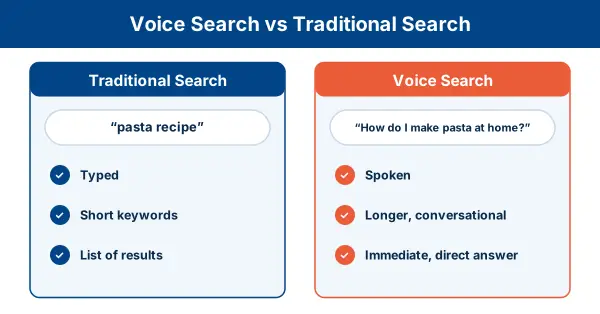
Today, Voice Search Optimization is more than just a playful functionality; it has become an important part of SEO. One of the major reasons behind the popularity of voice search is that speaking is easier than typing, and it saves time.
How to Optimize for Voice Search
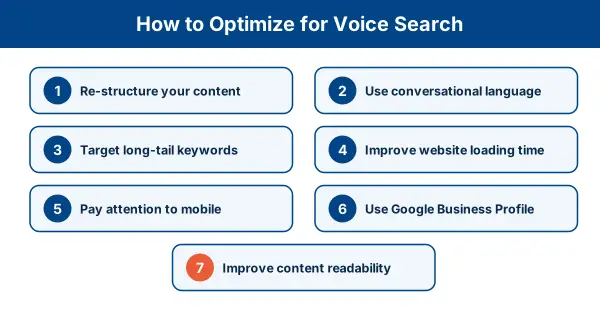
The popularity of Voice Search Optimization has led marketers and businesses to incorporate it into their marketing strategy by:
- re-imagining and re-structuring their content;
- using conversational language;
- targeting long-tail keyword phrases;
- improving the loading time of their websites;
- paying attention to mobile;
- leveraging Google Business Profile listings (formerly Google My Business); and
- improving content readability.
Conclusion: Make Voice Search Part of Your SEO
Thus, in an era of competition where Voice Search SEO is gaining more and more popularity, it is advisable to make a habit of optimizing your content for voice search to get better rankings and increase your organic reach.
